
90 Years of CMLL: 1960's
Mil Máscaras, El Solitario, Rayo De Jalisco, and Dr. Wagner burst onto the scene while Los Rebeldes dominate.
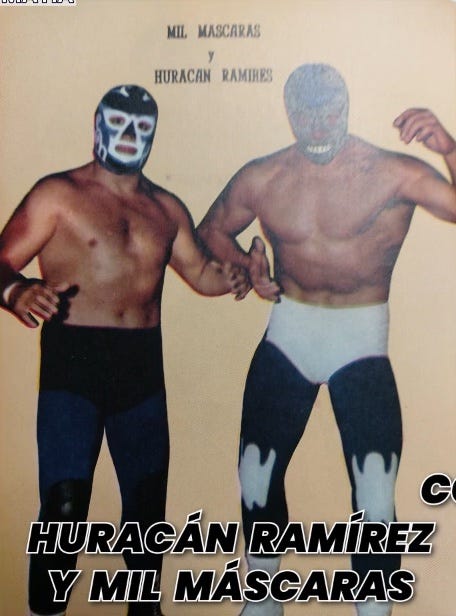
It’s 1933 in Mexico City and the promotion that would come to be known as CMLL begins as EMLL (Empresa Mexicana de Lucha Libre). Fast forward to 2023 and the company produces a series of videos commemorating their 90th anniversary. These are their highlighted moments and images celebrated throughout the series along with a few extra notes that I found interesting.
Watch the full CMLL produced series with this YouTube Playlist. I’ve linked to Luchawiki profiles as well as LuchaDB throughout to help people learn more about these important figures in lucha libre history.
(Note: I’d recommend opening this in a web browser so you can see all the images. There are a lot of really interesting ones.)

Don’t miss the bonus notes section at the end, it’s full of lots of interesting history! A fascinating decade in wrestling history.
1960’s
1960: El Enfermero reaches his peak winning mask versus hair matches over Humberto Garza (Apr. 3 Arena Coliseo) and Alex Romano (Apr. 29 Arena Mexico), both on anniversary shows. El Rayo de Jalisco debuts and defeats El Enfermero (Jul. 3). Rayo will become one of Mexico's most beloved luchadors.


1961: Fray Nano, one of Mexico’s greatest sports journalists and key promoter of lucha libre, dies. He started La Aficion, Mexico’s first sports newspaper. The new Arena México's 5th Anniversary show features seven singles matches including Gori Guerrero vs. René Guajardo, El Santo vs. Karloff Lagarde, Black Shadow vs. Cavernario Galindo, and Blue Demon vs. El Gladiador. Rizado Ruiz emerges as a breakout start, notable for his unique hairstyle and agility. Ruiz was already a box office draw on the Pacific coast.


1962: Antonio Posa shocks the wrestling world by dethroning René Guajardo for the World Middleweight Championship at Arena México's 6th Anniversary. At EMLL’s 29th Anniversary, Guajardo redeems himself, regaining the title in a bloody battle.


1963: Television enters the color era. The Robles Dynasty begins with brothers Manuel Robles and Huroki Sito forming a dominant team. They win the year’s premier tag team tournament (Feb. 10 Arena Coliseo) defeating Dick Medrano & Rudy Palma. El Santo has an extraordinary year retaining his mask against Benny Galánt (Mask vs. Hair) and winning Espanto I’s mask (Oct. 25). Both events set attendance records at Arena Mexico.


1964: Huracán Ramírez unmasks El Espanto III (Jun. 12 Arena México). Rayo de Jalisco unmasks La Bestia (Aug. 12). Jamaican Dorrel Dixon and Joe Grant form one of lucha libre’s most dominant and exciting teams.


1965: The future legend Mil Máscaras makes his Arena Mexico debut in July after a successful debut in Guadalajara. Mil quickly becomes Mexico’s top wrestling attraction with his elegance, mask variety, and international star power. Karloff Lagrade wins a hair versus hair match with Cavernario Galindo. Huracán Ramírez unmasks Scorpio (Dec. 3 Arena México). Gonzalo Avendaño, the pioneer trainer, promoter, and referee, passes away.


1966: El Solitario makes his dazzling debut at (Sept. 6 Arena Coliseo). He loses a controversial match to Tony Reyna on a low blow but showcases what will make him a legend. Dr. Wagner and Ángel Blanco team up for the first time, beginning what will become “La Ola Blanca (The White Wave),” one of lucha libre’s most iconic teams.


1967: Ángel Blanco takes Angel Exterminador’s mask at the 34th Anniversary Show. Arena Revolución, an iconic venue in Mexico City’s south for the next 30 years, holds its first show on December 9th headlined by Mil Máscaras and Huracán Ramírez against La Ola Blanca.


1968: Arena México is used as a venue for the Mexico City Olympic Games so EMLL concentrates more events at Arena Coliseo. Huracán Ramírez unmasks El Enfermero at Arena México’s 12th Anniversary. El Solitario wins the hair of Cesar Valentino (Oct. 27).


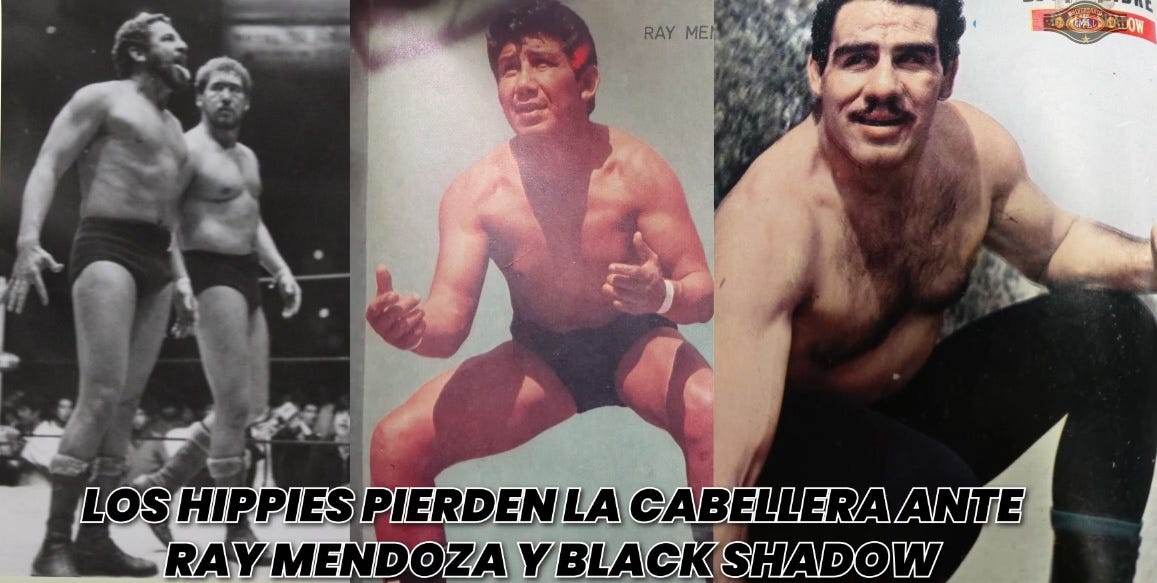
1969: Salvador Lutteroth forms the “Los Hippies” tag team of Renato Torres and El Vikingo. The Hippies rise through the ranks quickly but lose their hair to Ray Mendoza and Black Shadow during the 13th Anniversary of Arena México. Huroki Sito loses his hair to El Rebelde.
Up next, younger stars emerge in the 1970’s.
Bonus Notes
Rayo de Jalisco found quick success in the 60’s and formed a popular tag team with Blue Demon. His famous move, later adopted by his son Rayo De Jalisco Jr., was the reverse tope. He’ll appear in many movies in the 70’s and his fame at his peak rivalled that of Santo, Blue Demon, and Black Shadow.
Gori Guerrero became a free agent in the 60s and primarily wrestled in the U.S. for the rest of his career. El Santo officially became a tecnico in 1962 after Los Espantos turned on him. Santo and Blue Demon teamed for the first time ever on April 19, 1963 and teamed off and on after. Cavernario Galindo wrapped up his career in the 1960s as injuries forced him out of the ring. Blue Demon suffered a serious injury in 1965 that kept him out for a whole year. He continued to wrestle, make movies, and train wrestlers after.
René Guajardo and Karloff Lagarde became friends and rudo tag team partners known as "Los Rebeldes (The Rebels).” Lagarde was already a headliner and by teaming with him, Guajardo found himself in main events as well. The two also aligned with Ray Mendoza. They were also influential outside of the ring in improving conditions for the wrestlers. The Rebeldes split in 1967 and feuded. The three would leave EMLL in 1974 to join the new UWA promotion where they were featured. Rene was Wrestler Of The Year in 1962, 1965, and 1975. Rene & Karloff were Tag Team Of The Year in 1963 and 1965. Lagarde held three titles at once in 1964 and defeated El Santo and was Wrestler of The Year. Mendoza is considered the most important non-masked legend in lucha libre history. Mendoza’s tecnico turn and subsequent rivalry with Los Rebeldes drew big crowds and big money. Mendoza and El Solitario also had a huge feud in the late 60s that cemented Solitario as a main event player. Mendoza’s sons are Los Villanos (I, II, III, IV, V). Later on, Mendoza would become the lead commissioner of the Comisión de Box y Lucha del Distrito Federal which meant he was constantly featured on television. Mendoza passed away in 2003. Mendoza’s grandchildren Villano III Jr. and El Hijo del Villano III compete in current day CMLL.
Manuel Robles becomes a long time promoter of Arena Puebla. He passes away in 2014. His son now manages it. Robles other son is Panico, a successful wrestler and booker in CMLL. Huroki Sito’s son becomes Black Cat who wrestled all over including in New Japan.
Los Espantos were one of the first trios in lucha libre. Sadly Espanto I was killed in 1968.
The Huracán Ramírez character was popularized in film with the finishing move of “la huracarrana,” a variation on “la rana.” Daniel García Arteaga took on the Huracán Ramírez character and had lots of success in the 60s-80s.
Dorrel Dixon fell in love with Mexico during the Central American Olympics in 1954. He became a very popular tecnico during the 60s with a flying style and lots of charisma. He challenged Buddy Rogers several times in the U.S. for the World Heavyweight Title, including at MSG. Dixon is a Mexican citizen and still lives there.
Mil Máscaras is one of the most well known luchadors internationally due to his extensive touring of the U.S., Japan, and elsewhere. The Mil Máscaras characer was created for film and he took it into real-life. Mil appeared in many movies beginning in the mid-60’s which helped raise his popularity. He’s gone from EMLL before the decade ends as he first finds great success on Los Angeles where he wins the Americas Heavyweight Title. In the 70’s, he wrestles extensively for All Japan Pro Wrestling and the WWWF. His brothers are Dos Caras and Sicodélico.
El Solitario was one of the first wrestlers to use a mask with an exposed mouth. He rapidly became a star in the late 1960’s and was as popular as Santo, Rayo de Jalisco and Blue Demon when La Ola Blanca turned on him. La Ola Blanca were among hottest acts in Mexico. Solitario’s feud against Dr. Wagner is legendary and it takes until 1985 for them to settle it in a Mask vs. Mask match at the Plaza de Toros (Bullring) in Monterrey. You can watch that match here. Solitario sadly passes away in 1986 at just 39 years old. Solitario leaves EMLL in 1975 and was one of the biggest headliners throughout the whole country. La Ola Blanca also headline prominently in UWA and outside of EMLL.
El Enfermero rises to prominence as a partner of Medico Asesino for the Televicentro promotion. Later he joins La Ola Blanca with Dr. Wagner and Angel Blanco before stepping aside for El Solitario. He passes away in 1989.
Dr. Wagner is the father of Dr. Wagner Jr., who becomes a massive star in his own right. His grandsons, El Hijo Del Dr. Wagner Jr. and Galeno Del Mal are currently very successful pro wrestlers. His other son was Silver King who also had a very successful career before sadly passing away in 2019. Wagner was known as a mean, brawling rudo and one of the most complete wrestlers of his day. In 1986, Wagner crashed his car carrying other wrestlers and Angel Blanco died in the crash. It was just 20 days after Solitario’s passing. Wagner was left with serious injuries and had to learn to walk again with the assistance of a cane. Wagner passed away in 2004 at 68.
Rizado Ruiz’s brother Rodolfo was also a successful wrestler and a long-time CMLL referee. His son is Averno, who is still enjoying a long, successful career in CMLL.
Humberto Garza is father of the Hector Garza who passed away in 2013. Hector’s nephews are the current Los Garza (Angel & Berto). Humberto passes away in 2022.